A common AI learning mistake is asking for an answer, receiving a confident paragraph, and moving on too quickly. The answer may be mostly right, partly outdated, or quietly missing an important condition. The risk is higher when the topic is current, numerical, policy-related, technical, medical, legal, financial, or likely to be published for other readers.
This guide gives a practical source-check workflow for one concrete scenario: you ask an AI tool to explain a recent AI feature, policy, or technical claim, and you want to turn the response into a reliable study note. The goal is not to distrust every sentence. The goal is to identify which claims need checking, open the original sources, and rewrite the final note in your own words.
Start by separating the answer into checkable claims
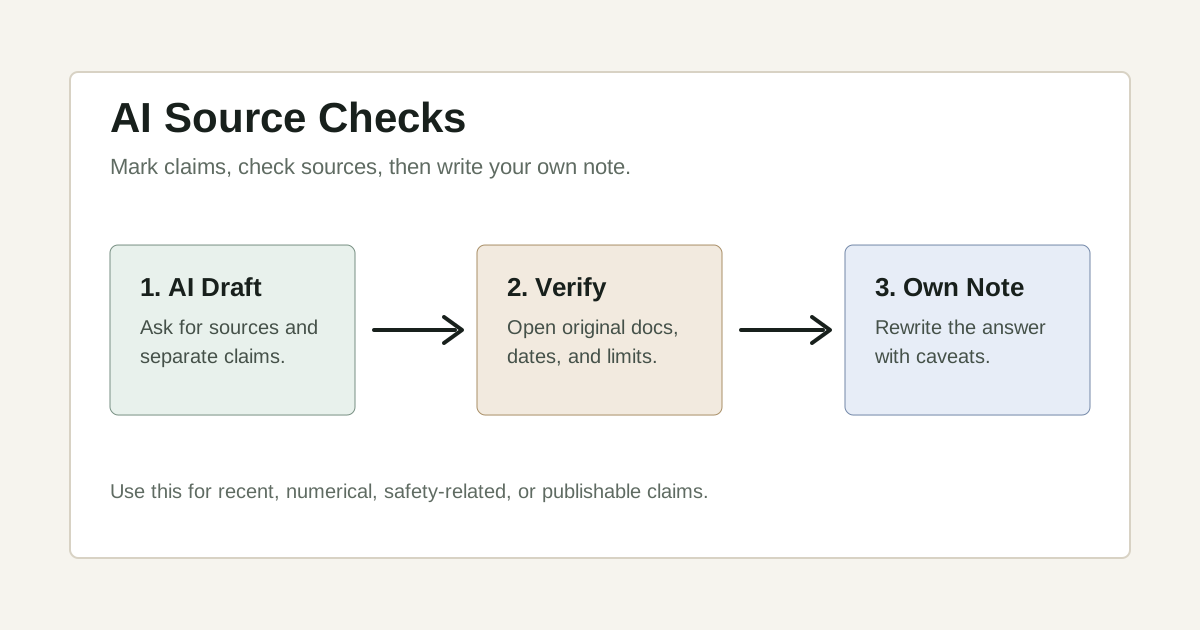
The first pass should not be a full fact-check. It should be a claim-marking pass. Ask the AI tool to separate its answer into individual claims, then label each claim by risk. A low-risk claim might explain a general concept. A higher-risk claim may include a date, product behavior, legal policy, safety instruction, benchmark result, or statement about what a company currently allows.
For example, suppose you ask: "Can I rely on AI-generated summaries for a research brief?" A weak answer might say that AI summaries are helpful, fast, and usually accurate when prompted well. That is too broad to verify. A better answer would separate claims such as: AI tools can summarize long material, summaries can omit context, current product features vary by tool, and published work should check important claims against original sources.
This step matches the way Google describes helpful content: readers should receive original value, clear sourcing, and enough context to trust the page. It also matches OpenAI's prompt guidance, which emphasizes clear, specific instructions and iterative refinement rather than treating the first response as final.
Move from answer-first to claim-first
A weak prompt asks for confidence without evidence: "Explain this AI update and give me sources." It may produce links, but it does not force the model to show which statement each source supports. It also does not tell the model what kind of uncertainty matters.
A stronger prompt is: "Explain this AI update for a beginner. Then create a table with three columns: claim, source needed, and why it matters. Mark any claim that is recent, numerical, pricing-related, safety-related, or dependent on a specific product version. Do not treat a source as support unless it directly confirms the claim."
The expected output changes in three ways. First, the answer becomes easier to inspect because claims are separated. Second, the model has to admit which claims need a source instead of hiding uncertainty inside fluent prose. Third, you get a checklist for your own work: open the original document, confirm the date, and rewrite the note with any limits included.
- Weak prompt: asks for an answer and sources at the same time.
- Improved prompt: asks for claims, source needs, and risk labels.
- Expected result: fewer vague summaries and more visible verification steps.
Check the original source, not just a citation
A citation is not proof by itself. Open the source and ask a simple question: does this page directly support the exact claim? If the claim is about a product feature, look for official documentation, release notes, or help center pages. If the claim is about risk, look for a standards body, a research paper, or a responsible organization with relevant expertise.
For current AI topics, dates matter. A help article updated recently can be more useful than an old blog post, but the opposite can also be true if the help article is general and the older document contains the actual technical detail. Read the surrounding paragraph, not just a highlighted sentence. Many mistakes happen when a source supports a narrower point than the AI answer claims.
NIST's AI Risk Management Framework is useful here because it treats AI risk as something to identify, measure, manage, and document. A personal learning workflow does not need enterprise paperwork, but it can borrow the same discipline: name the risk, decide how much checking is enough, and record what you verified.
Source-check failures I watch for
The most common failure is source laundering. The AI answer cites a real organization, but the linked page does not actually support the claim. Another failure is date drift: the answer describes a product behavior that was true in an older version but has changed. A third failure is summary flattening, where important limits are removed because the model is trying to be concise.
Prompt injection is another risk when AI tools read external pages. OpenAI has described prompt injection as instructions placed in outside content to manipulate an AI agent or browsing workflow. For ordinary learners, the practical lesson is simple: do not let external text decide your goal. Keep your verification checklist separate from the page being checked.
The final risk is over-correction. Some readers respond to AI mistakes by refusing to use AI at all. That is not necessary. A better habit is to use AI for structure, examples, and first drafts, then reserve final confidence for claims you have checked yourself.
My claim-check pass
For a study note, I first mark every recent or product-specific claim. Then I open the most authoritative source available: official documentation for tool behavior, Google Search Central for content quality questions, NIST for AI risk language, and the original research paper when a paper is being discussed. I write the source date beside each claim.
Next, I would rewrite the note without copying the source. The rewritten note should say what is confirmed, what is only a reasonable interpretation, and what remains unknown. If the claim affects a decision, I would add a short caveat such as "check the official documentation again before using this in production" or "this reflects the source as of the last updated date."
Finally, I would keep one sentence in my own words explaining why the claim matters. If I cannot explain why it matters, the claim probably does not belong in the note. This keeps the workflow focused on learning rather than collecting impressive-looking citations.
Continue learning on JoyfulGrid
Frequently asked questions
Do I need to fact-check every AI answer?
No. Prioritize recent, numerical, safety-related, policy-related, publishable, or decision-shaping claims. General brainstorming usually needs lighter checking.
Is asking for sources enough?
No. Sources must directly support the specific claim. Open the page, check the date, and confirm that the surrounding context matches the AI answer.
What is the fastest source-check habit?
Ask the model to turn its answer into a claim table. Then verify the highest-risk claims first instead of rereading the whole answer from the beginning.
Can this workflow make AI writing less generic?
Yes. A source-check workflow pushes the article toward specific claims, realistic limits, and original explanation instead of broad advice that could appear anywhere.
Sources
- Prompt engineering best practices for ChatGPTOpenAI Help Center
Used for guidance on clear prompts, specificity, and iterative refinement.
- Creating helpful, reliable, people-first contentGoogle Search Central
Used for the emphasis on original value, sourcing, expertise signals, and people-first usefulness.
- Google Search's guidance on using generative AI content on your websiteGoogle Search Central
Used for accuracy, quality, relevance, and context around AI-assisted content.
- AI Risk Management FrameworkNIST
Used for the risk-management framing behind identifying, checking, and documenting AI-related claims.
- Designing AI agents to resist prompt injectionOpenAI
Used for the explanation of prompt injection risks when AI systems read external content.