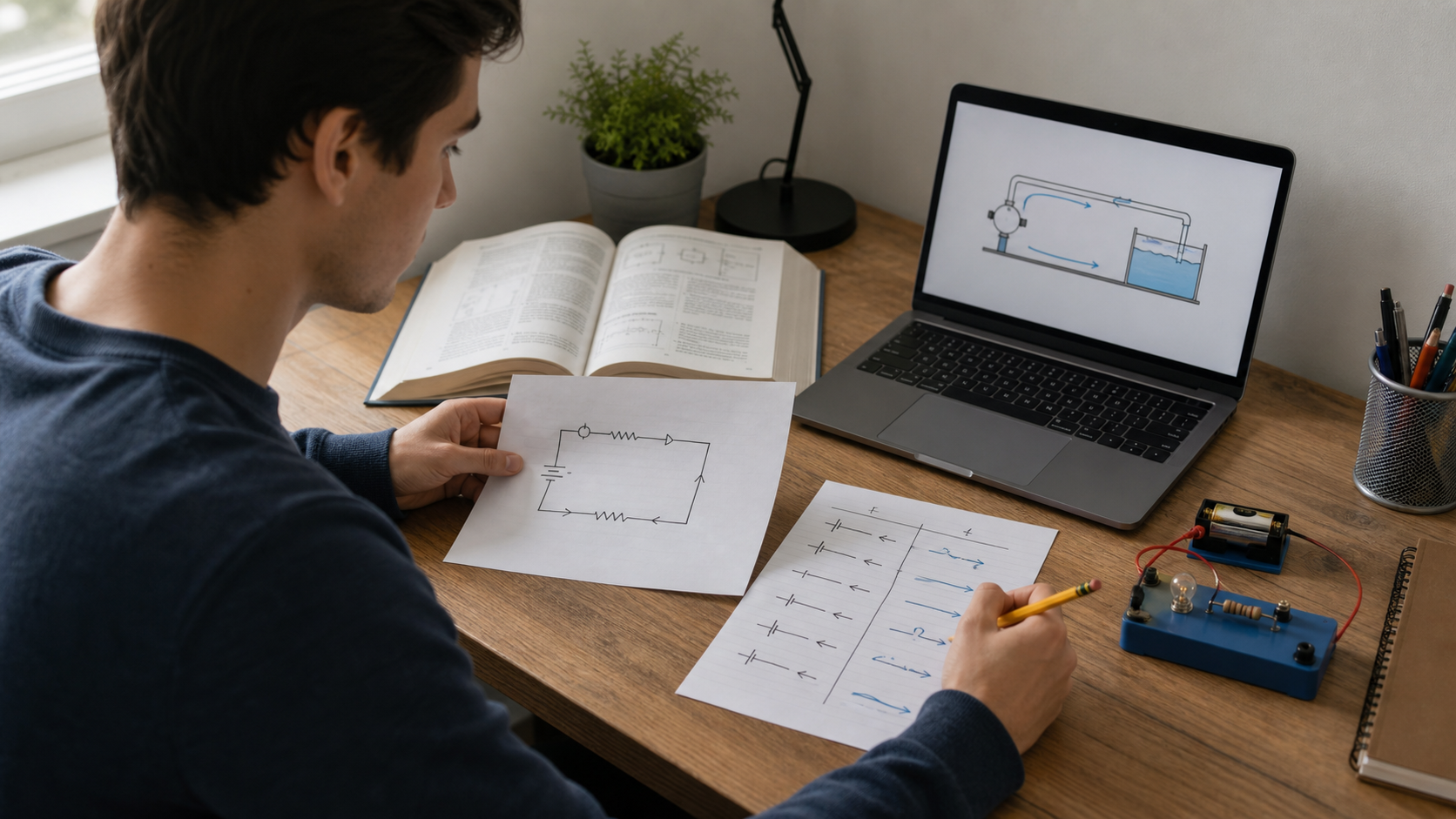
A learner is staring at a simple battery-and-resistor circuit. The textbook symbols feel abstract, so an AI assistant compares the circuit with water moving through a closed loop: the pump resembles the battery, pressure difference resembles voltage, water flow resembles current, and a filter resembles resistance. The explanation is vivid enough to repeat after one reading.
Then the learner is asked whether the resistor uses up the current. The water story suddenly becomes dangerous. If the familiar picture is remembered as water slowing after an obstacle, the learner may predict less current after the resistor, even though the current is the same throughout this simple series circuit. The analogy produced recognition, but its boundaries were never made visible.
AI is well suited to proposing familiar comparisons and revising them for a learner's level. That speed is useful only if the analogy is treated as a draft model, not a compact substitute for the subject. The workflow below turns a persuasive story into an auditable set of relationships, exposes where the match stops, and ends with a problem that cannot be solved by repeating the story alone.
The feeling of clarity is not the test
An analogy has a source, the familiar system, and a target, the system being learned. Dedre Gentner's structure-mapping account emphasizes relations rather than a loose collection of similar-looking objects. A pump and a battery are not useful merely because both can be drawn as boxes in a loop. The useful relation is that each supplies energy that maintains a difference across the system and supports flow under the conditions being modeled.
This distinction matters with generated explanations. A 2026 ACL study evaluated a modular pipeline for educational analogy generation across multiple language models. Its results showed that coherence scores were consistently higher than mapping and explanatory scores: models could produce comparisons that sounded intuitively plausible even when the structural correspondences were incomplete. That is a research result from particular datasets and evaluation methods, not a score for every chatbot response. It still gives learners a practical warning: smoothness is cheaper than a complete map.
Clarity can also distort self-judgment. In a series of experiments on science texts, Jennifer Wiley and colleagues found that analogies could reduce the accuracy of learners' judgments about what they understood when those judgments relied on superficial cues. A better confidence check asks what the learner can predict, explain, and distinguish after the analogy is hidden.
Anchor the target before choosing the familiar story
Give the assistant a small target sheet from a trusted course source before asking for an analogy. For the circuit lesson, the sheet might state that current is the rate of charge flow; voltage is electric potential energy per charge; a battery raises the charge's potential; a resistor transfers electrical energy to other forms; and the same current passes every point in a simple steady-state series loop. OpenStax's series-circuit lesson presents the water comparison alongside these target facts and explicitly notes the simplifying assumption of ideal conducting wires.
The target sheet is not a full chapter. Keep three to six statements that the analogy must preserve, plus the learner's level and the exact question they are trying to answer. If the authoritative material gives conditions, keep them. 'The same current flows everywhere' is too broad; 'the same current flows at every point in this simple series circuit at steady state' gives the model a boundary it can respect.
Ask the learner to mark each target statement as understood, uncertain, or unfamiliar before the AI responds. That quick inventory prevents personalization from becoming guesswork. An analogy built from a restaurant kitchen may be familiar to one learner and an extra system to learn for another. The source must actually be known well enough to carry the comparison.
- Target: the exact concept and the decision or prediction the learner must make.
- Ground truth: a short excerpt, diagram, equation, or instructor-approved note.
- Conditions: the assumptions under which each statement holds.
- Prior knowledge: what the learner genuinely understands about the proposed source.
Turn one clever paragraph into a mapping ledger
Weak prompt: "Explain electric circuits with an easy water analogy." This invites one polished story without saying which circuit, which relationships matter, or where the comparison should stop. It also lets the assistant quietly add target facts that were never checked against the course material.
Improved prompt: "I am learning a simple steady-state series circuit with one battery and one resistor. Use only the target facts below. Propose one familiar closed-loop water system as the source. Return a five-column ledger: target element or relation; source counterpart; shared relation; evidence from my target facts; boundary or non-match. Include current, voltage, battery, resistor, and the closed loop. Do not claim that the systems are identical. If a row is not supported by my material, label it unverified. End with one prediction question about the circuit, not the water system."
Expected output: a row might map electric current to water flow rate because both measure an amount passing a cross-section per unit time. Its evidence points to the supplied definition. Its boundary states that moving charge in a metal is not water and that the comparison does not make voltage literally equal to pressure. Another row maps the battery to the pump because each supplies energy to restore a potential difference, while noting that the battery does not manufacture charge in the simple circuit model.
The ledger forces the assistant to expose the middle of the reasoning. Read it horizontally, one row at a time. Does the source counterpart exist? Is the shared relation actually shared? Does the cited target fact support the row? Is the boundary specific enough to stop an incorrect inference? Delete decorative matches that add imagery but do not help answer the learning question.
Write the break column while the analogy is still useful
Do not save limitations for a final disclaimer. Put each break beside the mapping it constrains. In the water circuit, a narrow filter can help represent opposition to flow, but it should not teach that charge disappears in a resistor. The resistor changes electrical potential energy and transfers energy, while charge is conserved. The loop also should not suggest that the battery creates a fresh supply of charge on every trip.
Some breaks belong to the physical source; others belong to the simplified target model. Real wires have resistance even when an introductory diagram treats them as ideal conductors. A water system has fluid dynamics that are not part of Ohm's law. Once capacitors, alternating current, semiconductor behavior, or transients enter the lesson, the original mapping needs to be rebuilt rather than stretched until it explains everything.
Jee and colleagues describe analogical learning as retrieving a known source, aligning source and target by common relational structure, and drawing inferences from that alignment. Each inference is therefore a checkpoint. Ask: 'Which relationship licenses this prediction?' If the answer is only 'because that is what water does,' the reasoning has crossed the boundary without evidence from the target.
- Literalization: treating voltage as pressure rather than a limited comparison.
- Attribute leakage: importing color, speed, substance, or direction from the source.
- Scope creep: extending a steady-state DC analogy to a different circuit regime.
- Conservation error: implying that a component consumes the flowing charge.
Use a second base to reveal what the first one hid
A second analogy is useful when it maps the same target relation through different surface details. For voltage around a loop, OpenStax also uses a walk through hilly country: returning to the starting point means the total height gained equals the total height lost, just as voltage rises and drops sum to zero around the circuit. That comparison says less about current, but it makes the energy accounting easier to inspect.
Do not ask for two synonyms of the same water story. Ask for a second source with different objects, then compare the ledgers. Keep the target relationship that survives both mappings; mark relationships supported by only one source for separate checking. If the pump story and hill story both preserve a rise supplied by the source and drops across components, that relational pattern is more valuable than either picture by itself.
Research on transfer supports practicing a concept across varying examples, with appropriate caution about the domain and task. In four experiments using geological-science material, Andrew Butler and colleagues found better transfer to new application questions after retrieval practice with different examples than after repeated retrieval with the same example. That finding does not mean that two analogies automatically teach a circuit. It supports varying the context and then testing whether the learner can retrieve the underlying rule in a new one.
Make the learner predict in circuit language
Close the chat and remove the water diagram. Present a simple series circuit with a 9 V battery and two ideal resistors, 3 ohms and 6 ohms. Before calculating, the learner should predict where current is the same, where voltage changes, and which conservation idea supports each prediction. Then calculate: the equivalent resistance is 9 ohms, the current is 1 ampere, and the voltage drops are 3 V and 6 V. The drops add to the battery's 9 V rise.
The arithmetic is not the whole verification. Ask the learner to explain why the current after the 6-ohm resistor is not smaller than the current before it, and why the larger resistor has the larger voltage drop when the same current passes through both. Check the explanation and calculation against the course source or a measured circuit, not against the assistant's approval.
Next, change the representation. Show a circuit diagram without the water picture, a table of measured voltages, or a new pair of resistor values. If the learner needs to reconstruct the entire analogy before every step, the source is still carrying too much of the task. If they can name the target rule, solve, and check the result, the analogy has done its job.
- Prediction: state what should happen before using an equation.
- Target explanation: use charge, potential difference, resistance, and conservation language.
- Independent check: compare with a textbook result, instructor key, simulation, or safe measurement.
- Representation change: repeat once without the original picture or wording.
Four quiet failures to catch before they become notes
The unfamiliar-source failure occurs when the assistant chooses a hydraulic, financial, or biological system that the learner only partly understands. The analogy then doubles the learning load. Replace it with a source the learner can explain unaided, or skip analogy and use a direct example.
The decorative-match failure produces a memorable cast of objects but few shared relations. A battery is called a manager, charge becomes workers, and the resistor becomes a checkpoint; the story is lively, yet it may not preserve quantities or conservation. Ask for the relational ledger and remove characters that have no predictive role.
The ungrounded-boundary failure appears when the assistant writes generic cautions such as 'all analogies have limits.' Require a specific wrong inference beside every important mapping. The self-grading failure appears when the same chat proposes the analogy, invents the test, and certifies the answer. Separate generation from judgment by bringing the target facts and final check from an independent source.
Finally, beware the endless-revision failure. A learner can spend longer perfecting the metaphor than studying the concept. Set an exit rule: one grounded target sheet, one primary ledger, one contrasting source if needed, and one unaided transfer check. If the comparison still needs pages of repair, teach the target directly.
Retire the picture when the rule can travel
A good analogy is temporary equipment. It lowers the entry cost of an abstract idea, exposes a useful relational pattern, and then steps aside. Keep the mapping ledger long enough to review the correspondences and the breaks, but do not make the learner memorize the source story as if it were the definition.
The durable record is smaller: the target facts, the conditions, one or two relationships that clarified them, the boundary that prevented a likely misconception, and the result of the transfer check. AI can generate candidates and ask comparison questions quickly. The trusted material establishes the target, and the learner's performance establishes whether the comparison helped.
When the learner can reason in circuit language, solve a changed problem, and explain where the water model would mislead, the analogy is finished. The best sign of success is not that the story remains vivid. It is that the target can now stand without it.
Continue learning on JoyfulGrid
Frequently asked questions
Should I ask AI to choose the analogy or supply my own?
Either can work. If you supply one, explain what you already understand about the source. If the AI proposes one, ask for two candidates and choose the source you can explain unaided. In both cases, ground the target facts first and require explicit non-matches.
How many analogies should I compare?
Usually one is enough to start and a second is enough to stress-test an important relation. More comparisons can add cognitive load and contradictory details. Add another source only when it reveals a target relation or limitation that the first one hides.
Can I use an analogy as evidence in an assignment?
Use it as an explanatory aid, not as the authority for a factual claim. Cite the textbook, paper, data, or primary source that establishes the target relationship. Follow the assignment's rules for AI assistance and disclose that use when required.
What if the analogy and the textbook disagree?
Stop extending the analogy. Recheck the textbook's conditions, ask an instructor or qualified source when ambiguity remains, and mark the mapping as rejected or unresolved. The source story never outranks the evidence for the target concept.
Sources
- Teaching Through Analogies: A Modular Pipeline for Educational Analogy GenerationAssociation for Computational Linguistics
Used for the 2026 modular generation framework and the finding that generated analogies can score higher on coherence than on mapping soundness or explanatory power.
- Structure-Mapping: A Theoretical Framework for AnalogyCognitive Science
Used for the distinction between surface similarity and the mapping of shared relational structure from a familiar source to a target.
- Analogical Thinking in Geoscience EducationJournal of Geoscience Education via Northwestern University
Used for the retrieval, alignment, inference sequence and the need to support learners in selecting and interpreting effective analogies.
- When Analogies Harm: The Effects of Analogies on MetacomprehensionLearning and Instruction
Used for evidence that analogies can impair the accuracy of comprehension judgments when learners rely on superficial rather than situation-model cues.
- Retrieving and Applying Knowledge to Different Examples Promotes Transfer of LearningJournal of Experimental Psychology: Applied
Used for the four experiments showing stronger transfer after retrieval practice across different examples than after repeated use of the same example.
- Series CircuitsOpenStax Physics
Used for the water-system analogy, the current and voltage relationships in a simple series circuit, the ideal-wire assumption, and the independent target check.