The nephron diagram looked finished. It had a clean loop, coloured arrows, tidy labels, and the visual confidence of a textbook plate. Then one arrow was traced. It sent filtrate from the distal convoluted tubule back toward the proximal tubule, reversing the sequence described in the assigned reading. The image was easy to admire and dangerous to memorize.
AI can help convert dense prose into a compact visual plan, but a generated picture is not evidence that the model has understood the mechanism. A learner also gains little from downloading a polished diagram and rereading its labels. The useful work happens when the learner selects the parts, states what each arrow means, compares those claims with a trusted source, and later rebuilds the structure without the picture.
This guide uses a simplified nephron pathway from OpenStax Biology 2e as a concrete case. It is a study-design example, not medical advice or a substitute for an anatomy instructor. The same method works for a historical timeline, a network request, a supply chain, or any topic where order, location, or movement matters.
A convincing picture can still encode the wrong model
Visual polish and structural accuracy are separate qualities. A recent comparative anatomy study evaluated six text-to-image generators with a standardized request for anatomically accurate human structures. The authors concluded that the tested outputs were not reliable enough for unverified medical-education use and required expert checking. That is a narrow result about anatomy images from the evaluated systems, not a verdict on every diagram or future model. It does establish a practical rule: realism cannot serve as the accuracy test.
The risk is larger than a misspelled label. A diagram can include the right nouns while placing them in the wrong order, attach an arrow to the wrong compartment, merge two different flows, or imply causation when the source states only sequence. Once that layout becomes the learner's mental picture, fluent recall can reproduce the error efficiently.
Define success before generating anything. For this session, success is not a beautiful kidney illustration. It is the ability to reconstruct the simplified filtrate path, distinguish it from the blood path, and explain in which direction reabsorption and secretion move relative to the tubule. A plain sketch that supports those decisions is better than a detailed poster that obscures them.
Make a claim ledger before you choose the shapes
OpenStax describes the renal corpuscle as the glomerulus and surrounding capsule, then gives the tubule sequence as proximal convoluted tubule, loop of Henle, distal convoluted tubule, and collecting duct. It separately describes blood entering the glomerulus through the afferent arteriole and leaving through the efferent arteriole, which then contributes to the capillary network around the tubule. Those are different routes and should not share one unexplained arrow style.
Turn the selected paragraphs into a small ledger. Each row needs an element, a relationship, the arrow wording, and a source locator. One row can read: proximal convoluted tubule → loop of Henle; means ‘filtrate next enters’; OpenStax Biology 2e, section 41.2, Renal Tubule. Another can read: tubule → surrounding circulation; means ‘reabsorbed substance returns’; section 41.2, Kidney Function and Physiology. If the source does not settle a detail, mark it out of scope rather than letting the layout invent an answer.
Limit the first diagram to one learning question. The nephron has far more structures, transporters, gradients, and regional differences than a single practice page should carry. A diagram about route order does not need every ion. A diagram about reabsorption locations needs a different source boundary and a different visual grammar. Compression is useful only when the omitted detail is deliberate.
- Part: the named structure or state that must appear.
- Relationship: next to, inside, receives from, sends to, or changes into.
- Arrow phrase: the exact verb the line is meant to express.
- Locator: section, paragraph, figure, page, or instructor-approved note.
- Boundary: a detail intentionally excluded from this diagram.
Ask the assistant for a diagram brief, not instant artwork
Weak prompt: "Make a detailed, accurate, colourful diagram of a nephron with all the important parts and processes." The request has no source boundary, no definition of important, no way to distinguish blood from filtrate, and no test for whether a decorative addition is true.
Improved prompt: "Use only the supplied excerpts from OpenStax Biology 2e section 41.2. Do not generate an image yet. Build a diagram brief for a beginner who must learn the simplified filtrate route and distinguish filtration, reabsorption, and secretion. Return four tables: required parts in route order; arrows with a three-to-seven-word meaning; exact source locator for every part and arrow; and excluded details. Use one line style for filtrate flow and a different line style for movement between tubule and circulation. Do not add percentages, ion-specific transport, hormone control, or anatomy not stated in the excerpts. Mark any uncertain relationship REVIEW rather than resolving it from memory. Finish with five checks a human should perform against the source figure."
Expected output: the assistant produces a route beginning at the glomerulus and capsule, followed by proximal tubule, loop of Henle, distal tubule, and collecting duct. Filtration, reabsorption, and secretion appear as separately worded movements rather than one generic set of arrows. Every row points back to the supplied section, and ion-specific detail is placed in the excluded list. A REVIEW marker appears if the excerpts do not support an exact placement.
The brief is inspectable text. Correct it before asking for a rough visual layout. If the assistant silently adds a familiar fact, remove it or provide the source that earns its place. Repeating ‘be accurate’ is not a substitute for controlling the evidence available to the model.
Audit arrows as sentences
Cover every label and read each connection aloud as a sentence: ‘filtrate moves from the proximal tubule into the loop of Henle’; ‘water and selected solutes move from the tubule toward circulation during reabsorption.’ If a line cannot be translated into a precise sentence, the diagram has not defined its own grammar.
Check three dimensions separately. Sequence asks whether A really comes before B. Location asks whether a part sits inside, beside, or across the correct boundary. Process asks whether the arrow represents material movement, information, causation, or merely the order used in the explanation. Two arrows that look alike but mean different things should be restyled or split into separate views.
Then reverse the check. Start with each source-ledger row and find where it appears in the diagram. This catches omissions that a picture-first review misses. Finally, compare the draft with the textbook figure and caption. A second AI pass can list discrepancies, but it cannot be the sole judge because it may preserve or rationalize the same mistake that produced the draft.
- Forward trace: follow one route from start to finish without jumping lines.
- Reverse trace: locate every approved ledger row in the picture.
- Boundary trace: check every arrow that crosses between compartments.
- Legend test: verify that one colour or line style has one meaning.
Separate the reference, practice, and audit views
Do not make one overloaded image serve every purpose. Keep a checked reference view with labels and a compact legend. Create a practice view with the same basic geometry but blank labels and no process verbs. Keep an audit view containing the claim ledger, source locators, and revision notes. The practice sheet should never quietly inherit a change that has not passed the audit view.
For a visual generator, request a simple draft only after the brief is approved, and expect to redraw or rebuild it when spatial accuracy matters. Text embedded in generated images can be misspelled, repeated, or attached to the wrong object. Adding labels afterward in a controllable editor is usually easier to inspect. In a class or clinical subject, use the instructor's approved figure as the reference and involve a qualified subject expert before distributing new material.
Give versions names such as route-v1 and route-v2 instead of replacing the file silently. Record the problem that caused each change: reversed sequence, ambiguous boundary, overloaded legend, or unsupported detail. This turns a wrong picture into a useful error record rather than letting it disappear after the model regenerates a prettier one.
The learner must perform the translation
Research on drawing does not support the simple claim that any picture improves learning. In a 2017 series of experiments, drawing academic definitions produced better later memory than copying them verbatim, while paraphrasing performed comparably to drawing. The important contrast was active translation of meaning, not artistic quality. A 2019 study also found that active components, especially motor information in its tested tasks, contributed to longer-term retention.
The boundary matters. Two 2024 experiments used annotated animations about greenhouse gases. Summarizing during pauses improved test performance relative to the control, but untrained drawing did not. The lesson was already highly visual, and drawing may not have forced a useful representational change. Do not add sketching merely to make a session feel active.
A 2025 meta-analysis of 14 studies comparing supported with unsupported generative drawing found no overall advantage for drawing support across comprehension or transfer. Its moderator analysis did find a benefit when the support specifically facilitated integration. The evidence base was small and heterogeneous, so the result deserves restraint. For this workflow, AI's best role is to expose relationships and locators that help the learner integrate words with a self-made picture—not to perform the final act of understanding on the learner's behalf.
Run the thirty-minute nephron reconstruction
Spend the first six minutes reading only the chosen OpenStax paragraphs and figure captions. Write the learning question at the top of the page: ‘Can I trace filtrate through the simplified nephron and explain the three movement terms?’ Build no more than ten claim-ledger rows.
Use the next six minutes to have AI format the ledger into a brief. Reject unsupported additions and rewrite vague arrow phrases. In minutes 12 through 18, make or inspect a rough reference sketch. Trace the filtrate route in one pass, then use separate marks for filtration, reabsorption, and secretion. Keep the textbook open for this audit.
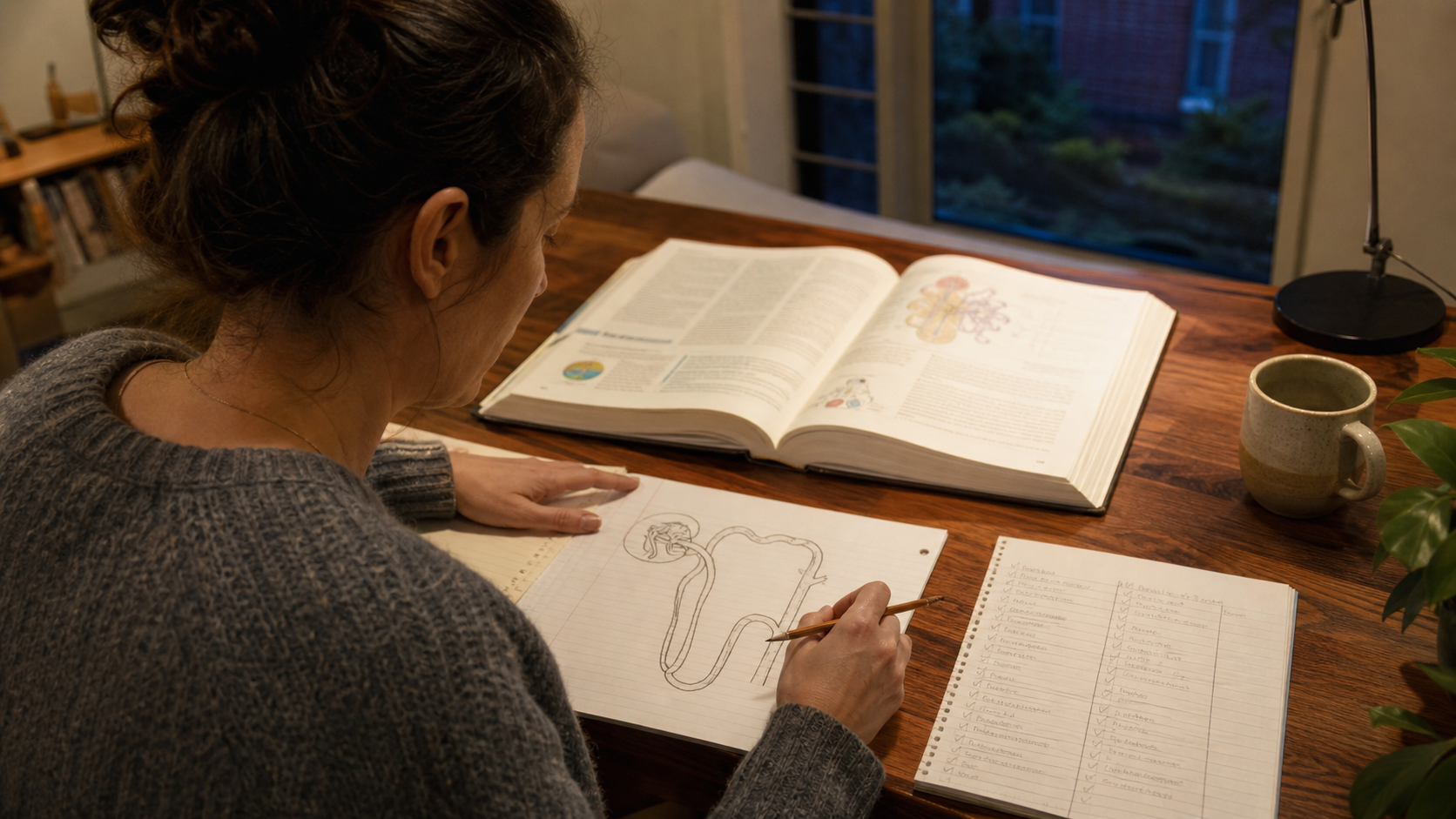
Close the source and hide the reference view. On a blank sheet, rebuild the route, add the three process arrows, and speak each arrow as a sentence. Open the audit view only after committing the drawing. Correct in a different colour and classify each miss as a missing part, reversed sequence, wrong boundary, vague process, or diagram defect.
Finish with one changed question rather than another copy: explain why reabsorption and secretion need opposite arrow directions, or trace what the route would still require if all ion-specific labels were removed. Schedule a blank-page redraw for the next day. If the second drawing works only when the original layout is visible, the picture has become a cue rather than durable knowledge.
- Minutes 0-6: bound the source and write the claim ledger.
- Minutes 6-12: produce and correct the text-only diagram brief.
- Minutes 12-18: audit a rough reference view against the source.
- Minutes 18-25: reconstruct from a blank page and explain each arrow.
- Minutes 25-30: classify errors and set the delayed redraw.
Stop when the visual starts inventing certainty
Retire or rebuild a draft when one arrow needs two incompatible meanings, a label has no source locator, decorative detail is remembered more clearly than the target process, or the generator changes verified structure while fixing a cosmetic issue. Also stop when the source itself is too advanced or ambiguous for your current question. A diagram cannot repair a poor source boundary.
Watch for false completeness. A clean loop can imply that nothing important has been omitted, even though the diagram intentionally excludes capillary detail, gradients, and hormonal regulation. Put the learning question and exclusions beside the audit version. Simplicity should announce its boundary rather than masquerade as a complete anatomical model.
The finished artifact is not the polished reference image. It is the dated blank-page drawing, the short spoken explanation, and the error record that shows what changed after checking. Keep the AI-generated view if it helps you practise, but trust the structure only to the extent that every relationship survives the source and reconstruction tests.
Continue learning on JoyfulGrid
Frequently asked questions
Should I ask an image generator to create the final study diagram?
Only when the subject and stakes allow careful inspection. Approve a source-backed text brief first, keep labels editable, and compare every relationship with a trusted reference. For medical, safety-critical, or assessed material, use instructor-approved visuals and expert review.
Do I need to be good at drawing for this method?
No. The goal is to translate relationships into a form you can explain and reconstruct. Boxes, lines, and consistent arrows are enough. Artistic polish can consume time without improving the learning target.
How is a study diagram different from a concept map?
A concept map emphasizes named relationships among concepts. This workflow is for spatial or process diagrams where route order, compartments, and arrow direction must also be checked. Some topics can use both, but they need different audit questions.
What should I do when the AI and textbook figure disagree?
Pause the diagram and return to the assigned text, caption, and instructor guidance. Record the disagreement instead of asking the same model to vote on its own answer. If the source remains unclear, mark the relationship unresolved and seek a qualified human explanation.
Sources
- Evaluation of Generative Artificial Intelligence Models in Producing Anatomically Accurate Illustrations: A Comparative Study of Text-to-Image GeneratorsClinical Anatomy via PubMed
Used for the current, anatomy-specific warning that visually generated structures from the six tested systems still required expert verification; the article does not generalize its result beyond that scope.
- Without Integration, Everything Is Nothing: A Meta-Analysis of the Effectiveness of Instructional Support for Drawing-to-LearnEducational Psychology Review
Used for the supported-versus-unsupported drawing synthesis, its null overall findings, heterogeneity, and the integration-support moderator.
- Generative learning activities for online multimedia learning: when summarizing is effective but drawing is notFrontiers in Psychology via PubMed Central
Used for the two annotated-animation experiments showing a boundary condition in which untrained drawing did not improve the tested outcomes over the control.
- Learning terms and definitions: Drawing and the role of elaborative encodingActa Psychologica via PubMed
Used for the experiments comparing drawing, verbatim transcription, and paraphrasing when learning academic definitions.
- Drawing improves memory: The importance of multimodal encoding contextCognition via PubMed
Used for evidence about the active, motoric, pictorial, and elaborative components examined in the drawing effect.
- Drawing-to-Learn: Does Meta-Analysis Show Differences between Technology-Based Drawing and Paper-and-Pencil Drawing?Journal of Science Education and Technology
Used as an earlier meta-analytic source on drawing-to-learn and the importance of comparing tools, tasks, and instructional conditions rather than treating all drawing as equivalent.
- 41.2 The Kidneys and Osmoregulatory OrgansOpenStax Biology 2e
Used as the bounded content source for the nephron parts, filtrate route, blood-vessel distinction, and filtration, reabsorption, and secretion example.